Ducks

Eagles love to eat ducks

Posted in Ducks, Farming, Predators on April 14th, 2011 by Nathan – Be the first to comment

Can you find the eagle in the tree?

It’s not uncommon for us to have eagles come by, but we got to know one up close & personal last week.

Most of our ducks are penned up in 5′ x 10′ open bottomed pens.  They get moved to fresh grass every day, but they don’t get to run free.  Our runner ducks are the exception.  They are too high strung & intelligent to be happy in a pen.  They are excellent foragers, and do a great job on holding the slug & bug populations down on our place.  At night, they are closed up for protection against raccoons, but at first light, they have been free to roam….    But not any more!

On Monday we heard the geese making a terrible noise.  When Kathy and I went out to see what was the problem, we discovered an eagle had decided to breakfast on one of these free range runner ducks. read more »

Selling blown duck eggs

Posted in Ducks, Eggs, Farming on March 25th, 2011 by Nathan – Be the first to comment

Abigail helps blow the eggs for breakfast

The value of my eggs tripled this week.  I just sold a dozen duck eggs on ebay this morning for $16.50, shipping not included.  The best part is that I got to eat them before they sold!

I’m moving into the egg shell business.  Blown goose eggs move out pretty regularly–I’ve already promised to ship off the rest of the ones I get this spring.  The surprise came when I found out that there is a market for blown duck eggs too! read more »

Got thin eggshells?

Posted in Chickens, Ducks, Eggs, Farming, Fluoride info, Geese, Pastured Poultry on June 8th, 2010 by Nathan – Be the first to comment
Joel has been our chicken farmer
In my experience, an egg with a thin shell is a problem that can be easily corrected.  In order to put a shell on its egg, the chicken mainly uses calcium, phosphorus & vitamin D.  If any one of these factors is missing, the bird will not be able to create a healthy shell.

Eggs with thin shells, weak shell, and even NO shells comes up as a topic every once in a while at our place.  It happens to a couple birds in our flock a few times each year–encouraging me to keep up my discipline in my farm management routines. read more »

Naturally hatched ducklings

Posted in Ducks, Farming, Pastured Poultry on May 19th, 2010 by Nathan – Be the first to comment

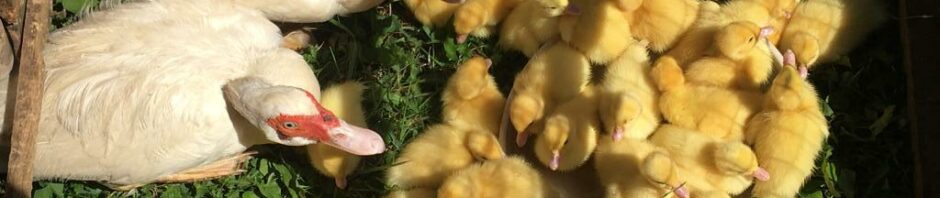
8 of 9 eggs hatched by "Mama duck", a Welsh Harlequin

I love natural nesting because it lets the birds do the work–they do a much better job than I do.

About 2 weeks ago, the first of our broody ducks produced a nice hatch.   I had kept her in one of the goose pens, under the protective umbrella of the “watch gander” as she sat for 28 days on her 9 eggs.   The gander couldn’t care less about protecting the duck, but I put the duck’s nest box right nest to the goose’s nest, so he didn’t have a choice.

Before the ducks start sitting, I collect the excess eggs to keep the count down to about 8-11 per nest.  A bird can cover up to 12, but there’s often one or two more that come after she’s on the nest full time.  Leaving a whole clutch of eggs is a good way to make a duck go broody.  It hasn’t failed me yet, although sometimes it takes a week or two before she get’s the idea of what she’s supposed to do next.

I make a note on the calendar for when a bird starts sitting, and 2 weeks later I’ll candle the eggs with a flashlight at night.  I pull out any infertile or otherwise dead ones to make a little more room in the nest.

"Mama Duck" keeps the ducklings warm, the pen protects them from crows

For the first few days after they hatch, the ducklings stay real close to mom.  After that, they get hungry and start to go out foraging.  The problem is the ducklings fit through any hole that’s larger than 1-1/2 inches across.  This means they are foraging all over the place while mom’s protection is stuck on the wrong side of the fence.  All 8 ducklings made it through day 7, and then one disappeared.  On day 9, Samuel and I saw a crow fly away with another duckling, so we immediately moved the remaining little ones into a portable pen.  They don’t get to forage through as much grass this way, but it’s better than losing them all to crows.

In a couple more weeks these little ones will have grown enough so the fence will hold them in and the crows won’t bother them anymore.  Until then, I bring them a shovel full of worm-filled compost every morning to make up for the bugs they aren’t getting elsewhere.

Chicken tractors for ducks

Posted in Chickens, Ducks, Farming, Pastured Poultry on April 21st, 2010 by Nathan – Be the first to comment
We’ve been raising ducks, geese & chickens since 2005.

Our current design for portable pens has been very successful with ducks & chickens, so I am posting the materials list & designs here so you can try it yourself.   

Because these portable pens are designed these for ducks, there are no laying boxes.  I’ve added one to the pen that has our chickens in it, but I’ve only included a photo of it in the instructions.  Contact me if you would like to get more detail than can be seen in the picture.   

Samuel and his ducks

One of the main criteria for these pens was to keep them light enough so my 8-year old boy could move them on his own.  I think the 5×10 ft size is a good compromise for capacity & weight.  They have worked very well for us.  Generally each pen holds a total of 8 adult ducks for eggs.   During the summer, we kept about 15 meat birds in the same space and you could go with a higher density than that if you are willing to move them twice a day.  The ducks generate a lot of mud during the winter rainy season here in western Washington, so we’ve kept the population down to ease the burden on the grass.  

If you do give it a try, please let me know what you think of them, and how they might be improved.  

DuckPenConstructionInstruction.pdf  

DuckPenMaterialsList.pdf 

Techniques for natural nesting

Posted in Chickens, Ducks, Farming, Geese on April 5th, 2010 by Nathan – Be the first to comment
A question for Nathan about hatching chickens via natural nesting: 


So, my blue slate pair: she started laying about 3 weeks ago, in a provided dogloo with straw. the ducks also layed there, but since those were infertile (drake got eaten by an eagle), I removed them. the hen was a bit lazy at first, only staying in the nest about half the day. After about 2-4 days of that, she’s been sitting on them most of the day, and I think all night. today is about day 9 of her sitting more often. I was able to count 9 eggs total, during a recent outing of hers.   

?: is this spotty sitting problematic? I was thinking of waiting about 30 days total, and if there’s no activity, removing all the eggs, and hoping she’ll lay another clutch.   

?: if any hatch, can she be trusted to care for the chicks, or should i remove them to a brooder ASAP? Since they were layed over a nine day period (at least), will they hatch over the same period, or will they hatch together?   

?:can the poults eat medicated chick feed? or is there a more appropriate feed?   

I really appreciate your insight!   

Thanks,   

Doug   

Nathan Replies:    

This giant african dewlap gander is an excellent guard for his sitting mate

I’ve had some experiences that might be helpful.  You get to decide how it would apply to chickens, since I’ve worked mostly with geese & ducks over the past 5 years.   

Using a dogloo:   

Not recommended for geese—chickens may do better though.   

3 years ago I used a plastic dog house with plenty of straw as a nest shelter for a pair of ebden geese in our back yard.  It was quick & convenient, which are both strong positives in my book.  The ~6 eggs did not hatch however, even though the goose was a relatively good sitter.  On inspection, I could tell that the eggs were fertile, but did not progress past about the 10-day stage.  There were at least 2 issues here.  The main one was the goose had to sit on a flat surface instead of a cupped nest.  This allowed the eggs to scoot out from under the mom every once in a while and they got chilled.  The 2nd is goose eggs need the humidity from the ground to progress & hatch, and they didn’t get that either.  A 3rd potential problem is that late-stage gosling eggs need abundant fresh air during their last week of incubation to finish out, and that might have become an issue with the plastic floor.  With that said, we did have a broody chicken hatch out a gosling in a plywood box with straw, but it was only sitting on 3 eggs in a small (12”x8”) space.   

Inconsistent sitting:   

This doesn’t seem to be a killer as long as it only happens during the first week.  I’ve been concerned about this with a couple of our geese, but they were became much more disciplined after the first 5 days or so, and had successful hatches.   It is normal for geese to take a 10 minute break twice a day for food & water—it’s amazing to see their consistent timing.   

Checking on progress:   

I’ve candled the eggs at night with a flashlight and removed infertile or dead ones after day 7—that’s when you can see the blood vessels well enough to make a decision.  It’s encouraging to see them grow, and the mom doesn’t mind.  I don’t do this now because the gander is always on guard.  I love an aggressive gander on patrol, but it prevents me from checking the nest like this.   

When the eggs hatch both ducks & geese have behaved similarly.  They continue to sit for another day or two, but take progressively longer outings.  It’s important to put water for the chicks near the nest.  I also like to put feed nearby for them to find it to help ensure survival.  The babies will do best with mom, and she will keep them warm as needed.  We have had problems with independently minded chicks straying off on their own and disappearing due to crows, raccoons & owls.  This is a challenge since the chicks can fit through fences that adult birds can’t.  For goslings, the gander guards them by day, and the goose shelters them at night and during rain.  Drakes don’t seem to do much at all with the little ones—it all falls to mama duck for watching over ducklings.  I had one chicken hatch a gosling 4 years ago.  She was the best protector that gosling could have asked for.   She even kept me away from it!   

Hatching sequence:   

Hens and ducks will lay a fresh egg in the nest every day, and the goose every other day.  It stays cold, but viable.  As the bird gets broody, it will linger longer on the nest after every egg, sometimes for hours as she gets close to officially “sitting”.  I like to reduce the number of eggs to what the bird can cover—usually 8-10 eggs, and a single layer deep.  (There will be trouble if more than one bird can access the nest, or lay an egg next to a sitting mom—who will scoop it up into the nest.)   

When the eggs are cold, they do not progress.  Thus, when the broody mom starts to sit, all the eggs are at the same embryonic stage, and so they all progress at the same time.  This means that they will all hatch at the same time—usually the same day.   It’s a joy to hear the eggs calling through the shell on the day before they hatch!   

Medicated feed:   

Since I do waterfowl, I can’t do medicated feed.  My impression is that medicated feed is to prevent bacterial infection outbreaks in large populations of caged & contained chicks.  I’m doing free range birds, and emphasize healthy diets on healthy pasture.  My opinion is that your birds will do better with a non-medicated ration & access to grass.  The best results I’ve had was when I put out worm filled compost daily for the chicks & ducklings to pick through.  Because chickens scratch, they do much better at this routine.  I’ve successfully put a “working chicken” in my duck pens to turn the compost for them.   

Predators:   

I’ve had sitting birds taken by raccoons, which is why I’ve gone with guard ganders.  It worked last year on an experiment with one goose pair & one duck pair, so I’ve expanded it to 8 pens now.   

Fertility window:   

Last year’s rooster was causing problems for my 4 year old who was responsible to feed the hens, so it went into the stew.  We had the incubator running, so I continued to put the chicken eggs in to see how late they would hatch.  I had eggs hatch that were laid 30 days after the rooster was gone!   

My reason for doing natural nesting is to have the animals do the work instead of me.  It’s great fun to do a little bit of planning and then let nature run the way God designed it to go!   

With encouragement,   

Nathan